Selasa, 05 Juli 2011
Una asociación de pena ajena: Mensa
A mediados del 2001 hice el examen de MENSA (*), la cual es una Asociación Civil, con sede en el Reino Unido, en donde se aglutinan -supuestamente- las personas más inteligentes del planeta. Hice el examen, para así saber mi IQ (Intelligent Quotient), el cual supuestamente también, mide la inteligencia de las personas. De acuerdo a la inefable wikipedia:
"El cociente intelectual, abreviado CI (en inglés Intelligence quotient, IQ), es una puntuación, resultado de alguno de los tests estandarizados diseñados para medir la inteligencia. Fue empleado por primera vez por el psicólogo alemán William Stern en 1912, como propuesta de un método para puntuar los resultados de los primeros tests de inteligencia para niños, desarrollados por Alfred Binet y Théodore Simon a principios del siglo XX, de forma que pudieran compararse entre sí. En dicho método, se dividía edad mental por la edad cronológica, dando como resultado el mencionado cociente".
Creo recordar que una prueba similar fue desarrollada por Binet para "calificar" a quienes querían entrar a los Estados Unidos, a principios del siglo pasado. Dicho de otra manera, lo que el gobierno norteamericano quería en ese entonces, era un argumento para rechazar la solicitud para inmigrar a los Estados Unidos. Simplemente era un pretexto formal para evitar la entrada.
Pero "haiga sido como haiga sido", (Calderón dixit), el asunto es que se popularizó la idea de que la inteligencia podía ser medida y cuantificada. Y así nació formalmente la prueba del cociente intelectual, también conocida por IQ.
Pues bien, Mensa, como decía, es una asociación civil que por unas 12 libras te hace el examen de IQ. En mi caso, un amigo quiso que hiciésemos ese examen. Conocía a una chica que pertenecía a esa Asociación y podía hacernos dicho examen en la ciudad de México.
Así entonces, nos apersonamos a la casa de esta mujer de MENSA y ella nos puso en cuartos diferentes (éramos mi amigo, su novia de ese entonces y yo). Cada uno en un cuarto diferente, aislados de los demás. Nos dio el examen y nos dijo que teníamos 40 minutos para resolverlo. El pergamino contenía 40 preguntas, todas de opción múltiple. Cada pregunta mostraba secuencias de dibujos: bolitas, bolitas con rayas, bolitas con puntos y... había que poner la siguiente gráfica de acuerdo a cuatro opciones.
Las primeras 8 preguntas eran relativamente sencillas y las había hecho casi de inmediato. Pensé entonces que 40 minutos era mucho tiempo, pero... he aquí que empezó a complicarse el asunto: bolitas con rayas, bolitas con puntos, bolitas con rayas y puntos, bolitas solas... y ahora ¿cuál es la siguiente en la secuencia? Empecé a palidecer... No estaba tan fácil y cada nueva pregunta era más complicada. El examen, de esta manera, se podía hacer en cualquier parte del mundo, porque no se valoraba más que esta capacidad de asociación.
Iba por la pregunta 32 cuando abrió la puerta la mujer de MENSA. Me dijo: quedan 5 minutos. Entonces alarmado le dije: "no voy a acabar en ese tiempo". Me respondió. "Si no tienes tiempo suficiente, pon cualquier respuesta, pero entrega todo contestado". Y así, faltando un minuto seguí la sabia recomendación: "Ave María dame puntería" y contesté azarosamente las últimas preguntas. Salí del examen pensando que si sacaba 100 (la media) me tendría que dar por bien servido. Realmente me deprimió todo este asunto.
Al cabo de unas semanas, me llegó una carta con mi resultado. Había sacado 151 puntos, lo cual calificaba entre el 3% de la población más inteligente en el mundo. Pues bueno, eso significa que tuve buena puntería, porque francamente responder así me parece poco menos que ridículo. Así entonces, pensar que ése es mi IQ es una vacilada que nomás se la creen los de MENSA y aquellos que tengan un gran ego, pienso. A mí me parece una soberana burla.
Pero lo peor estaba por llegar. Con la carta de marras, MENSA me invitaba a suscribirme (claro, previo pago), de su revista para inteligentes. Pero no se crea que era una publicación de acertijos ingeniosos, no. Se trataba de una lista de personas que habían calificado más o menos con los mismos valores que yo, y así entonces, poder ponerme en contacto con estos seres tan inteligentes.
Por supuesto que los ignoré, porque me parece de entrada lamentable que "las personas dizque más inteligentes del mundo" hagan discriminación a partir de una medida tan poco confiable como el IQ. Vaya, se mostraron como los más racistas.
Olvidé el asunto finalmente y no supe más de MENSA. Por ahí tenía mi carta con mi flamante 151 puntos de IQ pero creo la perdí. Sin embargo, en el 2009 recibí una carta de Cinthia Reyes (presidente@mensa.org.mx), para que me uniera a MENSA - capítulo México. Le contesté esto:
Hola, Cinthia,
Hice el examen más por un reto que por otra cosa. La verdad es que me parece lamentable Mensa. Hay suficiente discriminación en el mundo para además aceptar a una pretendida organización que discrimina por cuestiones intelectuales, amén de que la inteligencia misma no es muy claro que se pueda medir como además, pretende Mensa hacerlo. Así que bien puedes quitarme de esta lista, porque no me interesa pertenecer a esta asociación que discrimina.
Pensé que esto sería suficiente, sin embargo, me contestó con esto:
Que tal, Manuel....
Me parece una verdadera pena -y lamentable, tal como tu describes- que consideres que los objetivos de Mensa son únicamente discriminatorios, si bien son el pretexto para reunir gente de acuerdo a un estándar -elegido por alguien más, con o sin razón-. El objetivo primordial de Mensa que el presente comité acoje es el de hacer cosas en beneficio de los demás y la forma de trabajar del presente comité busca unir Mensa con otro tipo de organizaciones -cosa que hemos empezado ya a hacer- a fin de hacer sinergia, no divisiones.
Como mencioné en alguna parte del correo de hecho es para eso que formamos una A.C., para poder obtener fondos y hacer proyectos reales de impacto en beneficio de los demás.
Te agradezco te tomaras la molestia en responder de cualquier manera y como comentario al aire, espero que la próxima vez que tomes un reto -que además te cueste- te tomes también la molestia de leer los objetivos detrás de aquello que juzgas.
Saludos cordiales....
Cinthia Reyes
Así terminó esta absurda historia. Aparte salí hasta regañado. Se ve que son personas muy inteligentes y poco tolerantes con una opinión adversa. No me cabe duda.
_____
(*) A quien le interese esta ridícula asociación en México, puede darse una vuelta a http://www.mensa.org.mx/.
Book Review: Final Exam
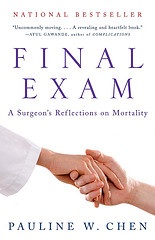
I recently read Pauline Chen's Final Exam, a narrative nonfiction on a surgeon's perspective on death and dying. It's interesting; many of the sentiments, experiences, and thoughts expressed in the book are reflected in my blogs over the last five years. The surgical approach, however, is fascinating. She speaks of issues specific to surgeons - the idea of performing an operation on someone who subsequently dies, the infamous morbidity and mortality conferences, the surgical culture.The writing in the book is excellent; it's clear, articulate, eloquent, graceful. The chapters read almost like essays with interwoven patient narratives and stories. To be honest, reading it felt like re-experiencing that which I'd already seen, so I don't think I particularly learned or gained much. It might not be the right book for a resident or physician. But I think it's a great read for the pre-med or interested layperson. The literature on death and dying perseverates on the disconnect between physicians and their familiarity, comfort, and understanding of the end of life. But what I'm trying to find goes beyond that - I know what it's like to care for a dying person, but my question is how we can change the system, structure, people, education, or expectations to make it better.
Image shown under Fair Use, from paulinechen.typepad.com
Senin, 04 Juli 2011
Eliminación de la tenencia
Marcelo Ebrard, jefe de gobierno de la ciudad de México, por muchos meses dijo que la tenencia no la iba a derogar en el DF, pues representaba unos 6 mil millones de pesos, con los cuales se subsidiaba el sistema de transporte público Metro. De acuerdo a sus cifras, el usuario paga 3 pesos por boleto, pero el costo real es de 9.60 pesos el boleto. Consecuentemente, más del 66% se subsidia y ese dinero sale precisamente del impuesto llamado tenencia.Pero la tenencia tiene una triste historia. Se promulgó un decreto -creo en 1962- para que se cobrara este impuesto a los automovilistas, para pagar las Olimpiadas de 1968. Supuestamente este impuesto se pagaría solamente dos años, pero como ningún gobierno tiene llenadera, esto se mantuvo hasta el 2011, es decir, la friolera de 43 años si las sumas no me fallan. Como que ya se pagaron y recontrapagaron las olimpiadas, ¿no?
Sin embargo, como Ebrard quiere ser el candidato del PRD a la presidencia de la república, se da cuenta que tiene que hacer méritos y entonces anunció hace apenas unos pocos días, que eliminaría el pago de la tenencia, medida que habíamos estado esperando los capitalinos. Ahora bien, dijo que para compensar este "boquete" financiero, se buscaría resarcirlo cobrando otro impuesto con algún mecanismo.
A ver, cretinísimo señor Ebrard: si elimina un impuesto, se elimina, no se le cambia el nombre para de nuevo cobrar lo que ya no se va a percibir por el pago del impuesto abolido. ¿Es que usted, señor Ebrard, inteligentísimo jefe de gobierno de esta ciudad no entiende eso? ¿Cree que cambiándole el nombre al impuesto será suficiente para que todos paguen contentos? Nos subestima. Me queda claro que como todos los gobernantes, cuando viven del presupuesto oficial, se les olvidan sus campañas, sus promesas, todo. Lo que quieren es dinero a toda costa. Ebrard ya decidió poner la nueva tarjeta de circulación cada 3 años, a unos 250 pesos, pero eso sí, sin ningún afán recaudatorio. Que le crea su madre sus mentiras. Solamente de esta tarjeta con chip sacarán unos 600 millones de pesos. Lindo negocio en donde no podemos no "comprar" la mercancía que se nos ofrece. Es a fuerzas o a fuerzas. Este país cada vez es más lamentable.
Farewell to Internal Medicine
It feels odd that the last year, I worked so hard to learn as much of internal medicine as I could, and now I'm changing fields. I really immersed myself in medicine, especially since it was a close second in career choice. I love it, and it seems core to what I've enjoyed in the last five years. I feel that I could have easily become a second year medicine resident. I will miss it. Medicine encompasses a lot of what I imagined when I thought of being a doctor prior to medical school, and I have a certain affinity to it. There are people who never liked the endless rounding, the theory and pathophysiology, the thinking but not doing - but I was never one of those people.
Now that I am starting a new and exciting field, I'm sure I'll keep my medicine tools handy; I'll continue to follow along peripherally and learn some of the cutting-edge developments. I'll read consultations closely because I enjoy it, I'll keep my experiences in the last year close to my heart. I'm sure I'll run into my colleagues in the hospital. Some say anesthesia is simply medicine of the operating room, and I hope that my internship will serve me well.
Sabtu, 02 Juli 2011
1300
This is the pale blue dot, Earth as seen from Voyager 1 at the edge of the solar system, 3,762,136,324 miles from home."Look again at that dot. That’s here. That’s home. That’s us. On it everyone you love, everyone you know, everyone you ever heard of, every human being who ever was, lived out their lives. The aggregate of our joy and suffering, thousands of confident religions, ideologies, and economic doctrines, every hunter and forager, every hero and coward, every creator and destroyer of civilization, every king and peasant, every young couple in love, every mother and father, hopeful child, inventor and explorer, every teacher of morals, every corrupt politician, every ‘superstar,’ every ‘supreme leader,’ every saint and sinner in the history of our species lived there - on a mote of dust suspended in a sunbeam.
The Earth is a very small stage in a vast cosmic arena. Think of the rivers of blood spilled by all those generals and emperors so that, in glory and triumph, they could become the momentary masters of a fraction of a dot. Think of the endless cruelties visited by the inhabitants of one corner of this pixel on the scarcely distinguishable inhabitants of some other corner, how frequent their misunderstandings, how eager they are to kill one another, how fervent their hatreds.
Our posturings, our imagined self-importance, the delusion that we have some privileged position in the Universe, are challenged by this point of pale light. Our planet is a lonely speck in the great enveloping cosmic dark. In our obscurity, in all this vastness, there is no hint that help will come from elsewhere to save us from ourselves.
The Earth is the only world known so far to harbor life. There is nowhere else, at least in the near future, to which our species could migrate. Visit, yes. Settle, not yet. Like it or not, for the moment the Earth is where we make our stand.
It has been said that astronomy is a humbling and character-building experience. There is perhaps no better demonstration of the folly of human conceits than this distant image of our tiny world. To me, it underscores our responsibility to deal more kindly with one another, and to preserve and cherish the pale blue dot, the only home we’ve ever known." - Carl Sagan.
Image shown under Fair Use, from Tecnoscience.
Jumat, 01 Juli 2011
July 1st
It amazes me that medicine is a field where every year on a prescribed day, the entire workforce of academic hospitals across the nation turns over. As I've mentioned in the past, for reasons I don't fully appreciate, July 1st is the day when new housestaff begin. Newly graduated medical students become interns; weary interns become residents; graduating residents become attendings or fellows. The entire hierarchy moves up a level on the same day. What other industry would dare do that? How could this tradition be sustained for decades? We all laugh timidly when we joke "July 1st is the most dangerous day to go to a hospital" but how true is this statement? Are we really doing those we serve a disservice by standardizing the day when everyone steps into new shoes and takes new roles?
This transition is not to be underestimated. Housestaff - interns, residents, fellows - essentially run the hospital. We make the gears turn. So on July 1st, a whole new cohort of faces must learn those hard skills that the outgoing interns spent a whole year learning. Even ignoring the aspect of medical knowledge, I remember trying to figure out how to get from ward to ward, send pages, put in orders, discharge patients. Of course, we all support each other, and the new residents remember vividly when (just yesterday) they were interns. So it all works out. Sort of.
I am sure there are benefits to this system, that somehow it's the way things must work with the academic year of graduating medical students, the importance starting a whole cohort together, the coordination between different hospitals that swap residents. July 1st may be here to stay, so I wish you best of health this month.
This transition is not to be underestimated. Housestaff - interns, residents, fellows - essentially run the hospital. We make the gears turn. So on July 1st, a whole new cohort of faces must learn those hard skills that the outgoing interns spent a whole year learning. Even ignoring the aspect of medical knowledge, I remember trying to figure out how to get from ward to ward, send pages, put in orders, discharge patients. Of course, we all support each other, and the new residents remember vividly when (just yesterday) they were interns. So it all works out. Sort of.
I am sure there are benefits to this system, that somehow it's the way things must work with the academic year of graduating medical students, the importance starting a whole cohort together, the coordination between different hospitals that swap residents. July 1st may be here to stay, so I wish you best of health this month.
Un muy interesante reportaje sobre Kasparov y Karpov
Paulino Aguilera llama mi atención a un interesante reportaje sobre Karpov y Kasparov, con motivo de los sesenta años de Anatoli.Vale la pena sin duda. Está en dos partes:
Parte 1:
Parte 2:
Que los disfruten tanto como yo lo hice.
Parte 1:
Parte 2:
Que los disfruten tanto como yo lo hice.
Langganan:
Postingan (Atom)