
Image shown under Fair Use, from Wikipedia.
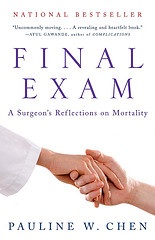 I recently read Pauline Chen's Final Exam, a narrative nonfiction on a surgeon's perspective on death and dying. It's interesting; many of the sentiments, experiences, and thoughts expressed in the book are reflected in my blogs over the last five years. The surgical approach, however, is fascinating. She speaks of issues specific to surgeons - the idea of performing an operation on someone who subsequently dies, the infamous morbidity and mortality conferences, the surgical culture.
 One of the great things about vacation is the time to read for fun. Steven Millhauser's The Barnum Museum is a collection of short stories, and I really enjoyed two in particular. The title story, "The Barnum Museum", is a story about a location that treads the quiet line between the real and the fantastical. This museum carries an air of mystique, and the atmosphere Millhauser creates is truly magical. The last story of the collection, "Eisenheim the Illusionist", is an amazing story, now made into a movie (The Illusionist 2006) about a magician during turn-of-the-19th century Vienna whose magic tricks take on more and more wondrous feats. In any case, I highly recommend those two stories for anyone who likes fiction that encroaches the border of magic realism.
 I recently reread the play W;t by Margaret Edson. I had initially read this as a freshman in college for one of my introduction to the humanities courses (I had taken a course called "visions of mortality" - which probably lead to my current fascination with death and dying). I was really struck by this 1999 Pulitzer Prize winner and the film version starring Emma Thompson. I do not read a lot of plays, and I'm not sure I even know how to read a play, but I can say that this short, easy read works a number on the emotions and strikes at the core of end-of-life care and oncology. It describes a professor of English with terminal cancer and her interactions with the oncologists and nurses as she undergoes chemotherapy. The play ties in the Holy Sonnets of John Donne, including Holy Sonnet X (below) which addresses death directly. The language of the play reflects the clinical encounters patients often have, and the self-reflection of the main character reveals the rich internal dialogue that presumably patients have as well. Overall, it is one of the best reads for understanding the patient perspective of cancer and I recommend it to everyone in medicine.
 Who Will Run the Frog Hospital? by Lorrie Moore is a novella I recently read, and I love it. It has nothing to do with medicine (do not worry, I did not hope to discover medicine in the title), but it was an easy piece of fiction a friend found for me. Lorrie Moore is a fantastic writer, and I had only read her short stories previously. But this book reads as one of her short stories; it is witty and conversant, aching of personal triumph and poignancy. This novella is a bildungsroman of a woman as she looks back at a loss of innocence and a time of transition in her young adulthood. But what it's about is not as important to me as how it makes me feel; her words have such a genuine ring as she prods and probes our own insecurities about adolescence. I would entirely recommend it as a good rainy-day read.
 Reading during residency is hard, but I picked up this book a while ago. I really enjoyed its predecessor Freakonomics, but to be honest, the sequel fell short of expectations. Although most of its topics are superficially interesting, it did not carry that interest through for me. Other than the chapter 0n global warming, I found the writing, research, and revelations to be lukewarm at best. They make a big deal over not having a "unifying theme" but I think that's what killed the book; the writing tried too hard and the train of thought wasn't all too coherent. Unfortunately, I would not recommend this book.
 Self-Made Man by Norah Vincent was one of the best books I've read in a long time. Written by a lesbian journalist, it recounts a 1 1/2 year experiment during which the author masquerades as a man in an experiment on gender, stereotypes, perceptions, and identity. She changes her wardrobe, dons a fake stubble, and takes voice lessons to pass as a man. She then joins an all-male bowling team, frequents strip clubs, dates women, joins a monastery, finds a job, and attends a John Bly mythopoetic men's movement group.
 I really enjoy Atul Gawande's writing, and The Checklist Manifesto did not disappoint. This book differs from his previous ones Complications and Better because it is not simply a collection of interesting stories and topics. Instead, it has a clear thesis promoting the use of the checklist. It reminds me of the previous books I reviewed, Internal Bleeding by Robert Wachter, another patient safety advocate. In this book, Gawande spreads his survey widely, looking at how top restaurants are run, how skyscrapers are built, and how international medicine is practiced. The timeliness of his book is amazing in that he describes very current events and how they played out.
 Robert Boswell's Mystery Ride is the latest fiction novel I've read. I was introduced to this book in the first creative writing course I took, a sophomore at Stanford. We read the first three chapters as an introduction to character and tension, and I was intrigued. I then met Robert Boswell at the Napa Valley Writers' Conference last summer. I really liked him; he was a captivating lecturer and his stories are hilarious and discomforting at the same time.
 Match Day by Brian Eule is a narrative account of three women as they approach that culmination of fourth year of medical school, match day. On match day, medical students across the country find out whether and where they are going to residency. To most, if not all, it's a stressful experience filled with uncertainty, second-guessing, and doubt. In this book, Brian Eule takes an almost anthropological approach in describing the entire process of specialty decision-making, residency interviews, and the ranking system. His only connection to medicine is his wife going through this process.